



The pipeline most contractors confuse with a prospect list
A real pipeline is sequenced, niched, and positioned before the solicitation drops. Everything else is a to-do list in disguise.
WE’LL COVER
Bottom Line Up Front — the pipeline distinction that changes everything
Week in Numbers — a real multi-tier client pipeline, mapped
Core Intel Report — why pipeline is a position, not a list (with the actual deliverable shown as proof)
The Edge — niche positioning as the compounding advantage
Pipeline Pattern Alerts — where to build next, by tier
Signal vs. Noise
Play of the Week — map your own local → state → federal pipeline this week
BOTTOM LINE UP FRONT
Most contractors are busy, not positioned. They open SAM.gov, download twenty solicitations, call it a pipeline, and submit on five they were never going to win. A pipeline isn’t a list of bids. It’s a sequenced, niche-filtered position across local, state, and federal buyers, built before the solicitation drops.
This issue breaks down the discipline, with a real client pipeline shown as proof.
WEEK IN NUMBERS
$4.85M — verified state budget mapped inside a single client pipeline, across three Florida Fish and Wildlife Conservation Commission solicitations (source: TEN30 Public Sector Growth Advisory snapshot, 10/1/26)
3 tiers — local, state, and federal, sequenced simultaneously in one plan
48 hours — standard execution window from pipeline delivery to first bid/no-bid calls
10 opportunities — tracked across tiers inside one geographic and capability niche
Each number is a decision filter. If an opportunity isn’t inside the niche, inside the tier sequence, or inside the execution window, it’s not pipeline. It’s noise.
CORE INTEL REPORT: Why Pipeline Is A Position, Not A List
Pipeline is the most misused word in government contracting.
Most contractors use it to describe a spreadsheet of opportunities they found on SAM.gov last week. That’s not a pipeline. That’s a to-do list.
A real pipeline has three characteristics: sequenced, niched, and positioned.
Sequenced means the opportunities aren’t random. They’re ordered by what you can actually win now, what you need to build toward, and what you’re positioning for 12 months out.
Niched means every opportunity sits inside your actual capability lane. If you’re a Miami civil/utility contractor, you aren’t chasing cybersecurity IDIQs because they looked interesting. You’re hunting in your lane and ignoring everything else.
Positioned means the pipeline accounts for registration status, bonding capacity, past performance gaps, teaming requirements, and site visit windows — before the bid/no-bid decision is even on the table.
Most contractors skip all three. They pull a list, chase whatever looks biggest, and burn capacity on bids they were never structurally positioned to win.
With my client’s permission, here’s what disciplined pipeline looks like in practice.
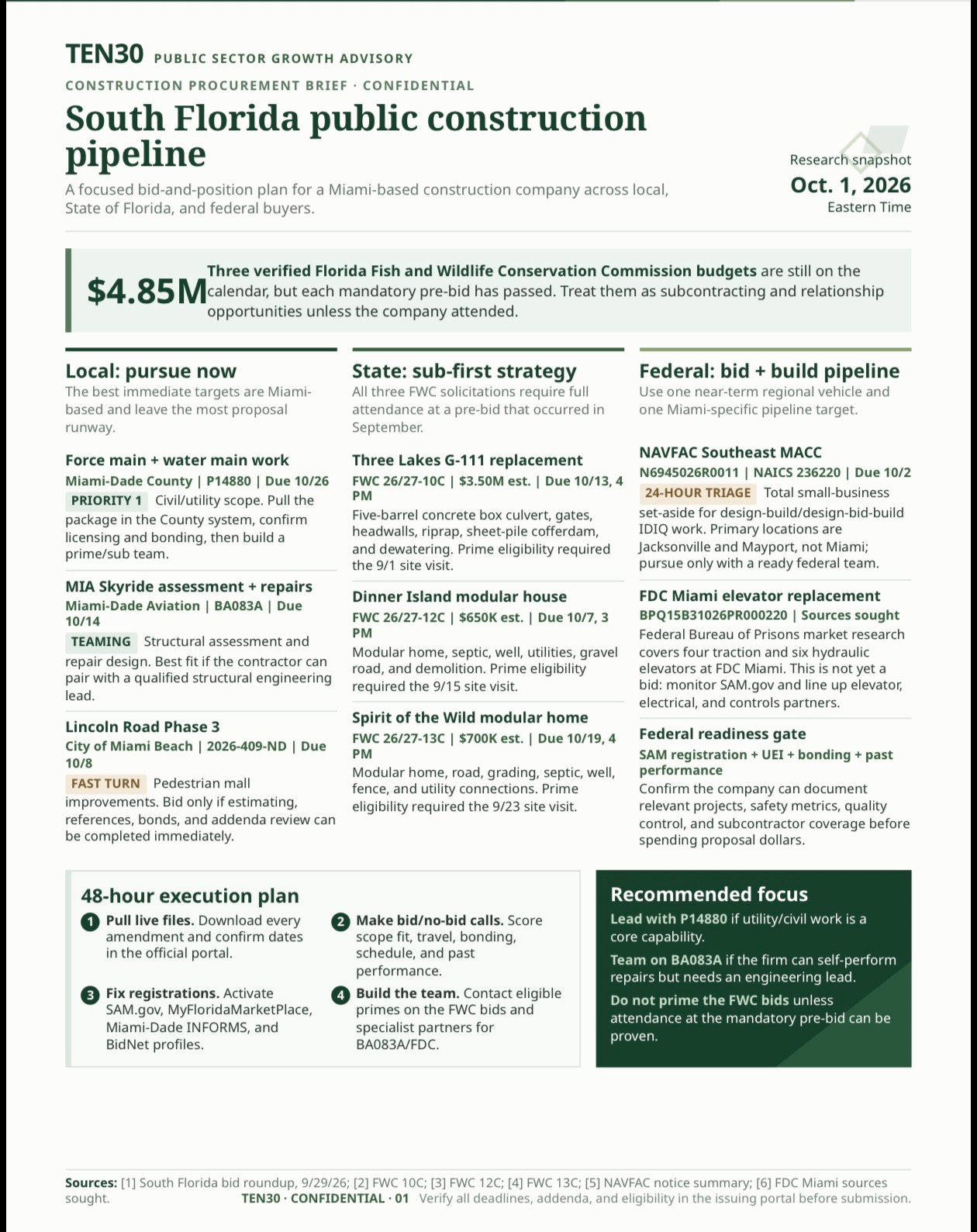
That’s a snapshot from a current engagement, a Miami-based construction company. One niche. Three tiers of buyer. Every opportunity mapped against capability, deadline, and positioning gap. The $4.85M in verified state budget sitting in the top-left callout isn’t projected revenue. It’s quantified exposure to a specific agency inside the client’s actual lane.
Look at how it’s structured:
Local tier — Miami-Dade County, MIA Aviation, City of Miami Beach. Fastest-moving targets with the most proposal runway. Priority one is a civil/utility package the client is positioned to prime directly.
State tier — three FWC solicitations that required mandatory pre-bid attendance. The pre-bids already passed. Instead of writing those off, the plan reframes them as subcontracting opportunities — the client can still participate, just in a different seat. That’s the difference between a pipeline and a list: a list drops them, a pipeline repositions them.
Federal tier — NAVFAC Southeast MACC and an FDC Miami elevator replacement. One near-term vehicle to triage, one longer-horizon sources sought response. Neither is in Miami. Both still build federal past performance that compounds into the client’s actual target geography.
That’s the Velocity Framework in practice. Local wins create cash flow and past performance. State positions the firm as a known buyer-side vendor. Federal builds the long-term revenue base. All three run in parallel, inside one niche, under one plan.
After 11+ years supporting $15.6M+ in federal contracts under a GSA prime, the pattern I see over and over: the companies winning consistently aren’t working harder. They’re working inside a position. The ones burning out are the ones with no pipeline discipline — treating every opportunity like it’s winnable because it exists.
What This Signals Next
Expect pipeline sophistication to become a bigger evaluator signal over the next 12 months. As agencies push toward category management and bundled vehicles, contractors who can demonstrate a coherent niche strategy — not scattered awards — will earn more teaming invites, more sources sought engagement, and more pre-RFP visibility.
The volume game is dying. The position game is the next decade.
Looking for advisory or consulting?
My firm’s website is down for maintenance while we build out the next version. In the meantime, if you’re exploring strategy, pipeline, or capture support for your government contracting business, reach out directly.
I’ll respond personally.
