


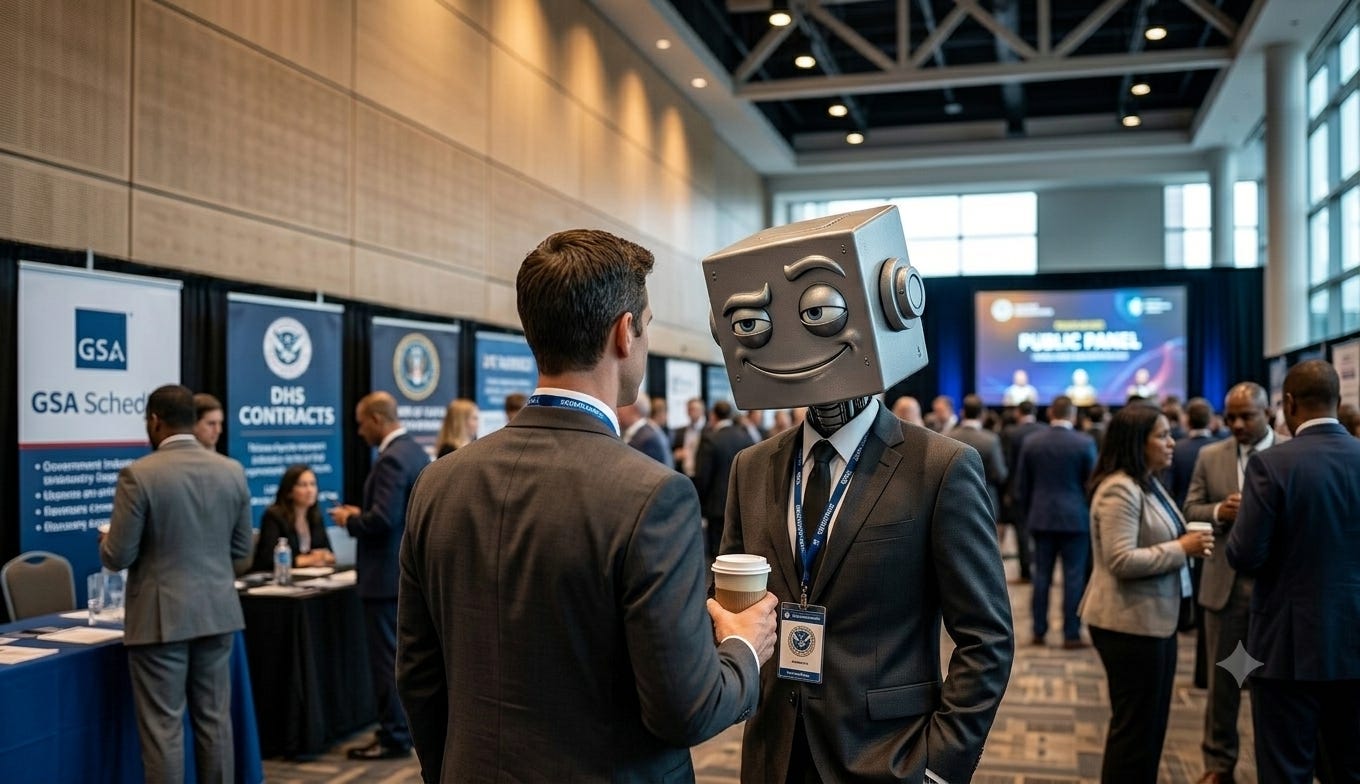
What Contracting Officers Actually Talk About At Industry Days
The stage gives you the press release. The hallway gives you the intel — and before the solicitation drops, the contracting officer is allowed to tell you far more than you think.
We’ll Cover
Core Intel Report — Stage vs. hallway, why the candor exists, and how to read what a CO is really saying
Week in Numbers — The rules that govern what a CO can and can’t tell you
The Edge: Sources Sought & RFIs — The only place a small business can legally shape a requirement
Competitive Advantage Monitor — Why showing up before the RFP is the whole game
Opportunity Alerts — Where to find industry days and market research notices now
Signal vs. Noise — The questions that build relationships and the ones that burn them
The Play of the Week — The post-event follow-up sequence that turns five minutes into a teaming agreement
Bottom Line Up Front
An industry day looks like an information session. It’s market research in disguise. Before a solicitation is released, contracting officers are not just allowed but encouraged to exchange information with industry — and that’s the window when a requirement is still soft enough to shape. Most contractors waste it collecting business cards. The ones who understand the room walk out having moved the requirement and started a real relationship.
Week in Numbers
FAR 15.201 — Exchanges of information between government and industry, from the earliest identification of a requirement through receipt of proposals, are encouraged. That’s the rule that makes the hallway conversation legitimate. They want to hear from you.
After the solicitation — Once the solicitation is released, the contracting officer becomes the focal point of any exchange, and anything disclosed to one offeror that’s needed to prepare proposals must be made public to avoid unfair advantage. That’s why they go quiet. Every candid thing they tell you afterward, they’d have to tell everyone.
FAR 3.104 — Every exchange must stay consistent with procurement integrity requirements. That’s the line a CO will not cross — not because they dislike you, but because crossing it can blow up the procurement.
The formal levers — Industry days, draft RFPs, requests for information, and one-on-one meetings are the named techniques agencies use for early exchange. These, not the keynote, are where influence actually happens.
Core Intel Report
Walk into any industry day and you’ll hear two completely different conversations.
On stage: the agency mission, the acquisition timeline, the org chart, and some version of “we strongly encourage small business participation.” It’s public, it’s vanilla, and it’s the same information that’s already in the notice. Useful for orientation. Useless as an edge.
In the hallway: whether the timeline is actually real or already slipping. Which incumbent is frustrating the program office. Whether the requirement is locked or still being written. Whether they’re leaning toward a set-aside. What’s keeping the program manager up at night.
That gap isn’t an accident. It’s the law.
Before a solicitation is released, agencies are encouraged to discuss acquisition strategy, contract type, feasibility, performance requirements, statements of work, and even evaluation criteria with industry. In other words, pre-solicitation, the CO is genuinely permitted to talk — because they’re doing market research and they need your input to write a requirement that works.
Here’s the part that separates operators from tourists: when a CO asks the room a question, that’s not small talk. That’s the deal being structured in real time.
When a contracting officer asks “is this timeline realistic?” — they’re deciding the schedule. When they ask “would a small business set-aside draw enough qualified competition?” — they’re deciding whether this becomes a set-aside at all. Your answer, right there in the hallway or in the Q&A, can move it. That is the actual product of an industry day, and most people walk past it to grab a coffee.
Reading between the lines. A few translations:
“We’re still doing market research” → the requirement isn’t locked. You can still influence it. Move now.
A sources-sought notice attached to the event → they’re deciding whether to set it aside. Enough capable small businesses responding is what triggers a set-aside.
Vague, hedged answers on timeline → it’s slipping. Don’t build your pipeline around the date on the slide.
Repeated emphasis on one capability → that’s the discriminator they’ll evaluate on. Build your pitch around it.
Questions that build vs. questions that burn. A CO remembers who asked what. Questions that build a relationship show you did the homework: “Your draft scope mentions X — are you envisioning that as a separate CLIN or bundled?” signals you read the documents and think like a partner. Questions that burn you mark you as a rookie who’ll be high-maintenance: “So how do I win one of these?” or “How do I get on your list?” tells the CO you haven’t done the basics and you’re here to take, not contribute.
What This Signals Next (analysis):
The hallway builds the relationship. The written response is where influence gets documented and remembered. After the event, the move that matters is responding in writing to the sources sought or RFI — that’s the record the CO actually carries into the acquisition. Relationship without a documented response fades; the paper trail is what shapes the requirement.
I’ve sat through plenty of these rooms from the contractor side across 11+ years under a GSA prime. The pattern never changes: the vendors who shape the requirement before it drops are the ones who win when it does. That’s the Velocity Framework in microcosm — position before you pursue.
The Edge: Sources Sought & RFIs
The hallway is where you’re remembered. Sources sought notices and RFIs are where you actually move the requirement — in writing, on the record. This is the single most underused lever a small business has.
Why it matters this quarter: Pre-solicitation is the only window where the
