


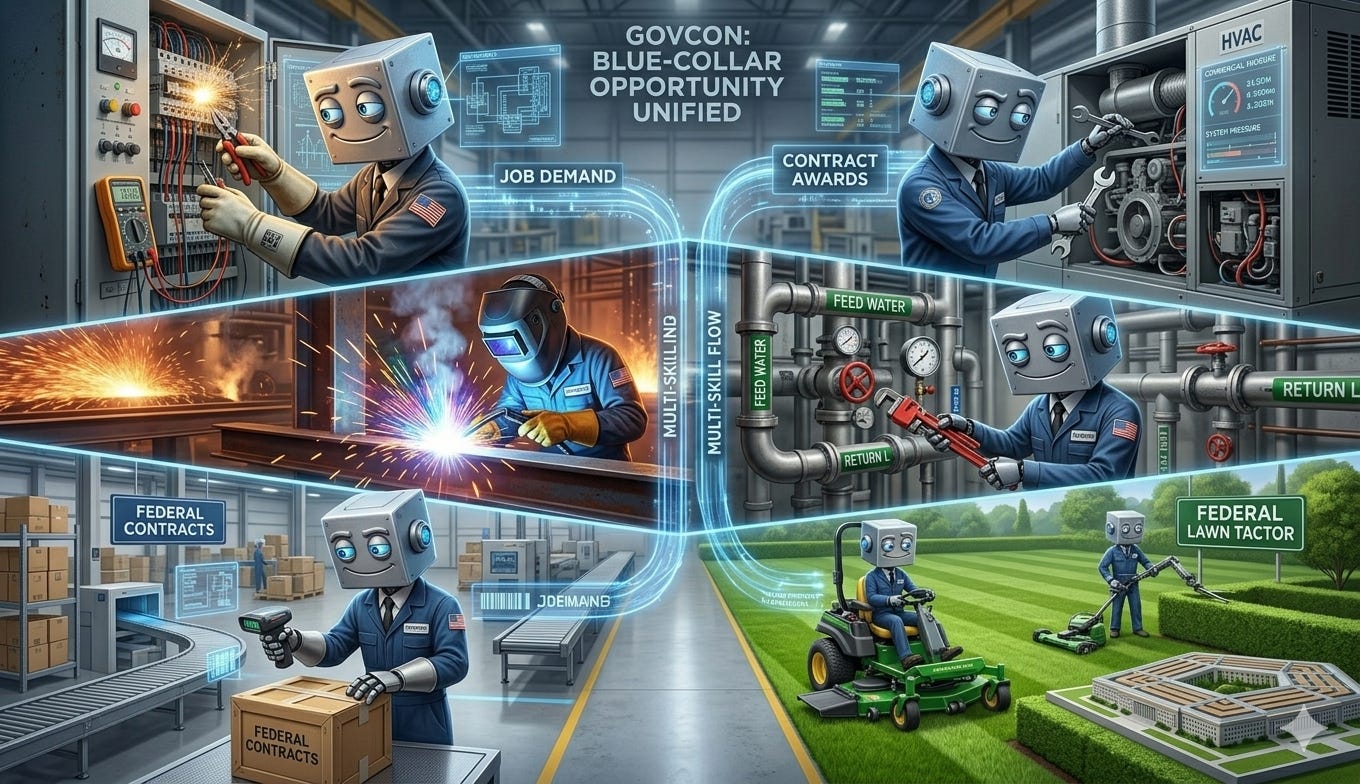
The Trades Run The Building
The government owns 360 million square feet of building space and is billions of dollars behind on maintaining it. Every one of those buildings needs electricians, HVAC techs, plumbers, welders, grounds crews, and logistics. This work is recurring, it’s funded, and most trade businesses never bid it.
We’ll Cover
The Building as a Stack of Work Zones — six trades, six revenue lanes inside every federal facility
The $17 Billion Reason This Is Heating Up — the maintenance backlog that becomes your pipeline
The Edge — the one vehicle built specifically for facility trades, and how small shops get on it
Opportunity Alerts — where bundled maintenance and grounds work is moving
The Play of the Week — five moves to position your trade for recurring federal work
This Week’s Win — a trades operator landing repeat facility work
Bottom Line Up Front
Federal contracting isn’t just consultants and software. The government runs 360 million square feet of buildings, and keeping them standing is a permanent line item — HVAC, electrical, plumbing, structural, grounds, logistics.
It’s also behind. GSA’s deferred maintenance liabilities now top $17 billion. That backlog isn’t a problem for trades businesses. It’s a forecast. The shops that get positioned on the right facility-maintenance vehicle this year catch work that repeats every option year, not a one-time job.
The Week In Numbers
Four figures. Each one is a reason a blue-collar business should be paying attention.
360 million square feet — GSA’s nationwide real estate portfolio. So what: that’s the floor space someone has to heat, cool, wire, plumb, and maintain — forever. Recurring demand, not a one-off.
$17 billion+ — GSA’s deferred maintenance liabilities, up from under $5 billion a decade ago. So what: a backlog this size means catch-up work is coming, and it gets bought through contracts.
$126 billion — products and services GSA oversees through federal contracts. So what: facilities, construction, and maintenance are a real slice of this, not a rounding error.
~$19 billion — building operations spending on the civilian side alone last year, one of the top service categories. So what: “building operations” is government-speak for the trades. That’s your category, and it’s near the top of the list.
[Sources: GSA portfolio and deferred-maintenance figures; GAO FY2026 government-wide contracting snapshot. FY2026 is the most recent completed year]
Core Intel Report:
Every Federal Building Is A Stack Of Work Zones
Walk into a federal facility and stop thinking of it as a building. Think of it as six revenue lanes stacked on top of each other. Each one is a trade. Each one is funded. Each one repeats.
GSA’s own maintenance specifications spell it out. The National O&M Specification covers heating, ventilation and air-conditioning, electrical, switch gear, plumbing, carpentry, roofing, structure, and energy systems. The custodial and grounds specification covers landscaping, grounds maintenance, and snow and ice removal. That’s not a wish list. That’s a procurement document — the work the government has already committed to buying.
Here’s how the trades map to the building.
Electrical. Switch gear, power distribution, lighting, backup systems. Federal facilities can’t go dark, so electrical work is preventive and constant — not “call someone when it breaks.” It’s named directly in the O&M spec.
HVAC. The single most reliable trade lane in federal buildings. Agencies run on strict temperature, ventilation, and energy-efficiency requirements, which means HVAC isn’t seasonal — it’s continuous monitoring, preventive maintenance, and refresh. Named in the spec, tied to energy mandates.
Plumbing. Water systems, fixtures, treatment, backflow. Unglamorous, essential, and recurring. Also named directly in the spec, usually bundled into the broader O&M scope.
Welding & structural. Less visible on the civilian side, heaviest on the defense side — installations, shipyards, vehicle and equipment repair, structural and infrastructure work. This is where trade work shows up at scale on military bases through base operations and infrastructure support. (Analysis: welding rarely contracts as its own line; it rides inside structural, installation, and depot-maintenance scopes — so the move is positioning under those, not chasing a “welding solicitation.”)
Logistics. Warehousing, supply, equipment movement, facility support. On military installations this lives inside Base Operations Support — large, recurring contracts that bundle logistics with the rest of facility operations. (Analysis: logistics is rarely standalone for small firms; it’s usually a piece of a bundled BOS award or a subcontract under one.)
Landscaping & grounds. Grounds maintenance, landscaping, snow and ice removal — named explicitly in GSA’s custodial spec. Low barrier to entry, genuinely recurring, and one of the most common first wins for a blue-collar business entering federal work.
What This Signals Next
(The trade-to-spec mapping above is sourced. What follows is analysis.)
Expect facilities and maintenance demand to hold steady or rise through FY2026 even as the government cuts elsewhere. You can’t defer a building into not needing power and water. And with a $17 billion maintenance backlog, the pressure is toward more catch-up contracting, not less.
The trend underneath it all: the government increasingly buys these trades bundled, not à la carte. It wants one contractor to maintain the whole building, or one prime to run the whole base. That changes your strategy — which is the next section.
The Edge: The Vehicle Built For The Trades
The play for facility trades is one specific vehicle: GSA’s Building Maintenance and Operations (BMO) contract — and its small business version, BMO SB.
Why it matters this quarter: BMO is a governmentwide, multiple-award IDIQ built specifically to buy facility maintenance and operations — the exact trades above. It carries a best-in-class designation, runs on a 10-year structure, and has both unrestricted and small-business set-aside tracks, with BMO SB adding socioeconomic categories on top. The government built a highway for facility trades. Most trade shops have never heard of it.
Who should move: electrical, HVAC, plumbing, grounds, and general facility-maintenance businesses that can either self-perform a scope or reliably subcontract it. Who shouldn’t: a one-truck operation with no capacity to staff a recurring task order — these awards expect you to show up every day, not once.
